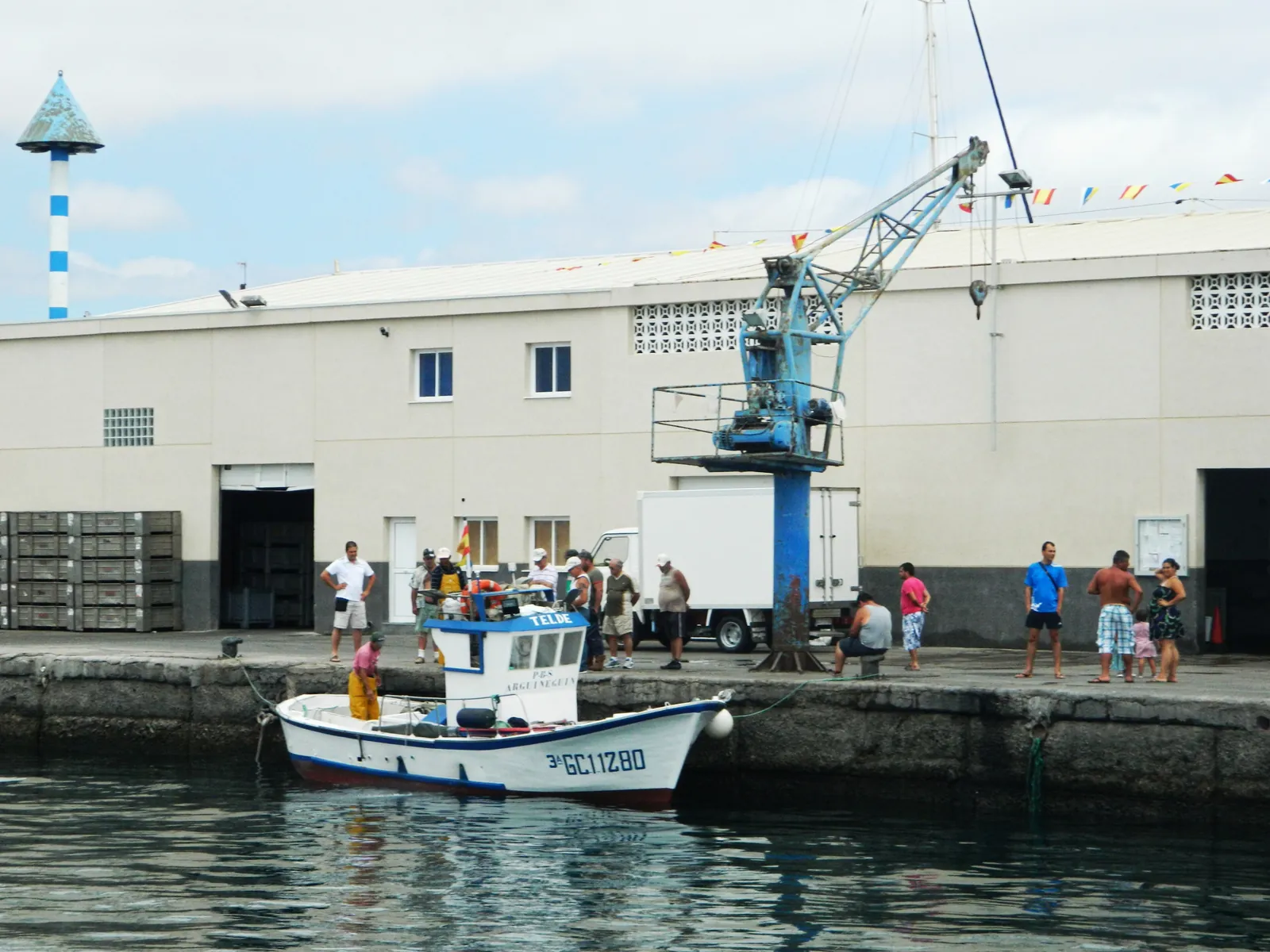
Arguineguín is the biggest fishing port on Gran Canaria, run alongside a fishermen's cooperative whose restaurant sits on the quay. You watch the work from the pier, and eat the catch next door.
Arguineguín's harbour is still a working fishing port, and Mogán council's tourism office describes it as the largest fishing port in Gran Canaria. It is also the base of the Cofradía de Pescadores de Arguineguín, the fishermen's cooperative, whose restaurant by the quay is the easiest way to taste the catch. The official port sheet lists no first-sale point at Arguineguín, so there is no public fish auction to attend; what you get is the sight of boats, nets and ice machines, plus a fishmonger and restaurants beside them.
This page explains how the port is organised, what you can see, how to behave on a working quay and where the harbour fits into the rest of the town.
What the harbour is, in numbers
The Puerto de Arguineguín is a regional port run by Puertos Canarios, the Canary government's ports body. Its published data gives a sense of scale:
| Item | Figure | Source |
|---|---|---|
| Main breakwater | 425 m | Puertos Canarios |
| Inner breakwater | 271 m | Puertos Canarios |
| Quay line | 398 m | Puertos Canarios |
| Pontoon berths | 154 | Puertos Canarios |
| Car park at the port | 138 spaces | Puertos Canarios |
| Fishermen registered with the Cofradía | 44 (port sheet) | Puertos Canarios |
| Fishing boats | 35, with 32 shipowners and 30 skippers | Mogán tourism |
| Crew | Up to 60 sailors, rising to about 200 in the tuna season | Mogán tourism |
| Excursion boats based here | 5 | Puertos Canarios |
The two sources are not dated and count different things, so treat the figures as an order of magnitude rather than an exact register: a few dozen boats, a few dozen working fishermen, and a seasonal surge when tuna arrive. The port is well sheltered by its breakwaters, which is why the calm water behind them also suits the town beach; see the town laid out area by area.
What a cofradía is
A cofradía de pescadores is a fishermen's guild: an association of boat owners and crews that represents them, organises the port's fishing business and, in many Spanish ports, runs the fish market. In Arguineguín the Cofradía also runs the waterfront restaurant. There are two Cofradías in Mogán, one here and one in Puerto de Mogán, and they should not be mixed up: they are separate organisations in separate harbours.
The founding date of the Arguineguín Cofradía and the details of how it sells its fish are not published, so no date is given. The longer story of how the fishing village became a resort town is in the history of Arguineguín.
What you can actually see
From the pier and the quay you can watch small coastal boats come and go, crews sorting gear, and people carrying boxes to the fishmonger's. The sight is genuine but unscheduled. No timetable for landings is published, because boats leave and return according to weather, catch and the tide of the season. So there is no reliable "best time to watch the boats come in", and anyone who gives you an exact hour is guessing. The practical approach is to walk the quay once in the morning and once in the late afternoon and see what is happening, rather than plan a visit around one moment.
If you want to see fish rather than boats, the fishmonger's by the harbour is the place, and the market on Tuesday adds fruit, vegetables and more; both are covered in the shopping guide. Opening hours for the fishmonger are not published, so ask locally.
Eating the catch at the Cofradía restaurant
The Cofradía restaurant is run by the cooperative at the port. Visitors typically go for fish soup, limpets (lapas) in green mojo sauce and the day's fresh fish, served with the Canarian wrinkled potatoes, papas arrugadas. It was operating in 2026 according to recent reviews. Menu and prices change with the catch, so none are quoted here; the Cofradía de los Pescadores review has the details, and the seafood guide compares it with other places in town.
Cofradía de Arguineguín versus Puerto de Mogán. The two guilds both have restaurants, and review sites sometimes mix them up. If you are navigating by map, check that the pin is on the quay in Arguineguín, not the one in Puerto de Mogán, 16 km away.
The boats that leave from the pier
Besides the fishing fleet, Arguineguín is a passenger harbour. Líneas Salmón and Líneas Blue Bird run scheduled boats to Anfi del Mar, Puerto Rico and Puerto de Mogán. Salmón's own fares for adults are €5 single to Anfi, €8 to Puerto Rico and €15 to Puerto de Mogán, with return tickets at €8, €14 and €21; timetables change, so check the operator before you travel. One practical point: Blue Bird says extra sailings run on market days. The routes, the viewpoints from the water and the dolphin trips are in boats from Arguineguín and, for the whale and dolphin trips, dolphin and whale watching.
Etiquette on a working quay
This is a place of work first. A few common-sense rules help:
- Keep clear of vehicles, winches and the edges of the quay, and do not step over nets or lines; they belong to someone's livelihood.
- Ask before photographing people at work, and never photograph a stranger's catch up close without asking.
- Do not feed or touch the fish, and do not take fish from boxes or buckets.
- Keep dogs on a lead and children close.
- If you want to fish for fun from the structures around the harbour, remember that recreational sea fishing in the Canaries needs a regional licence; check the current rules first, and see fishing trips and sea fishing.
The Fiesta del Carmen: the fishermen's feast
The harbour is also the stage for the town's main fishermen's festival. The Fiestas del Carmen are held in mid-July in Arguineguín and Puerto de Mogán, and include a maritime procession with decorated boats. The exact date of the sea procession varies from year to year and is announced locally, so check with the council near the time. The festival has its own page: Fiesta del Carmen.
A note on the pier in 2020
For three months in late 2020, the Arguineguín quay was used as a temporary camp for people arriving by boat from West Africa, run by the Red Cross on the Interior Ministry's behalf. It was emptied on 29 November 2020. The quay remains a reception point for boats intercepted by Salvamento Marítimo, so you may occasionally see rescue vessels or Red Cross staff at the harbour. It is normal port business, and visitors should simply leave the area clear.
Getting there and combining it with the rest of the day
If you are staying in town, the harbour is a few minutes' walk from the main beach and market squares. By bus, Global's lines 91, 90, 33 and 39 stop in Arguineguín; see buses in and from Arguineguín. Many people combine a harbour walk with a morning at the Tuesday market; the stalls are a couple of minutes away. The port has its own car park with 138 spaces.
Frequently asked questions
Is there a fish market in Arguineguín?
There is a fishmonger at the harbour, but the Puertos Canarios port sheet lists no first-sale point, so there is no public fish auction to attend. The Tuesday market is a general market rather than a fish market.
What is the Cofradía de Pescadores in Arguineguín?
It is the fishermen's guild of the port. It represents the local fishermen and runs the seafood restaurant on the quay.
How big is the Arguineguín fishing fleet?
Mogán's tourism office gives 35 boats, 32 shipowners and 30 skippers, with up to 60 sailors, rising to about 200 in the tuna season. The port authority lists 44 fishermen. The sources are undated, so treat these as rough figures.
What time do the fishing boats come in?
There is no published schedule. Boats return according to weather and catch, so walk the quay in the morning and in the late afternoon to see what is happening.
Can I take a boat from Arguineguín harbour?
Yes. Líneas Salmón and Líneas Blue Bird run boats to Anfi del Mar, Puerto Rico and Puerto de Mogán. Salmón's adult single fare to Puerto de Mogán is €15, but check the current timetable and prices with the operator.
When is the Fiesta del Carmen in Arguineguín?
It is held in mid-July, with a procession of decorated boats at sea. The exact date of the sea procession changes each year, so check locally close to the time.
Sources
- Puertos Canarios – Puerto de Arguineguín: breakwaters, berths, fishermen, excursion boats and regular lines
- Mogán tourism – Guild of Arguineguín: fleet and crew
- Mogán tourism – Port of Arguineguín
- Líneas Salmón – regular line, timetable and fares
- Líneas Blue Bird – ports and market-day sailings
- Mogán tourism – festivals, including the Fiestas del Carmen
- Diario de Avisos – the Arguineguín quay camp empties, 29 November 2020