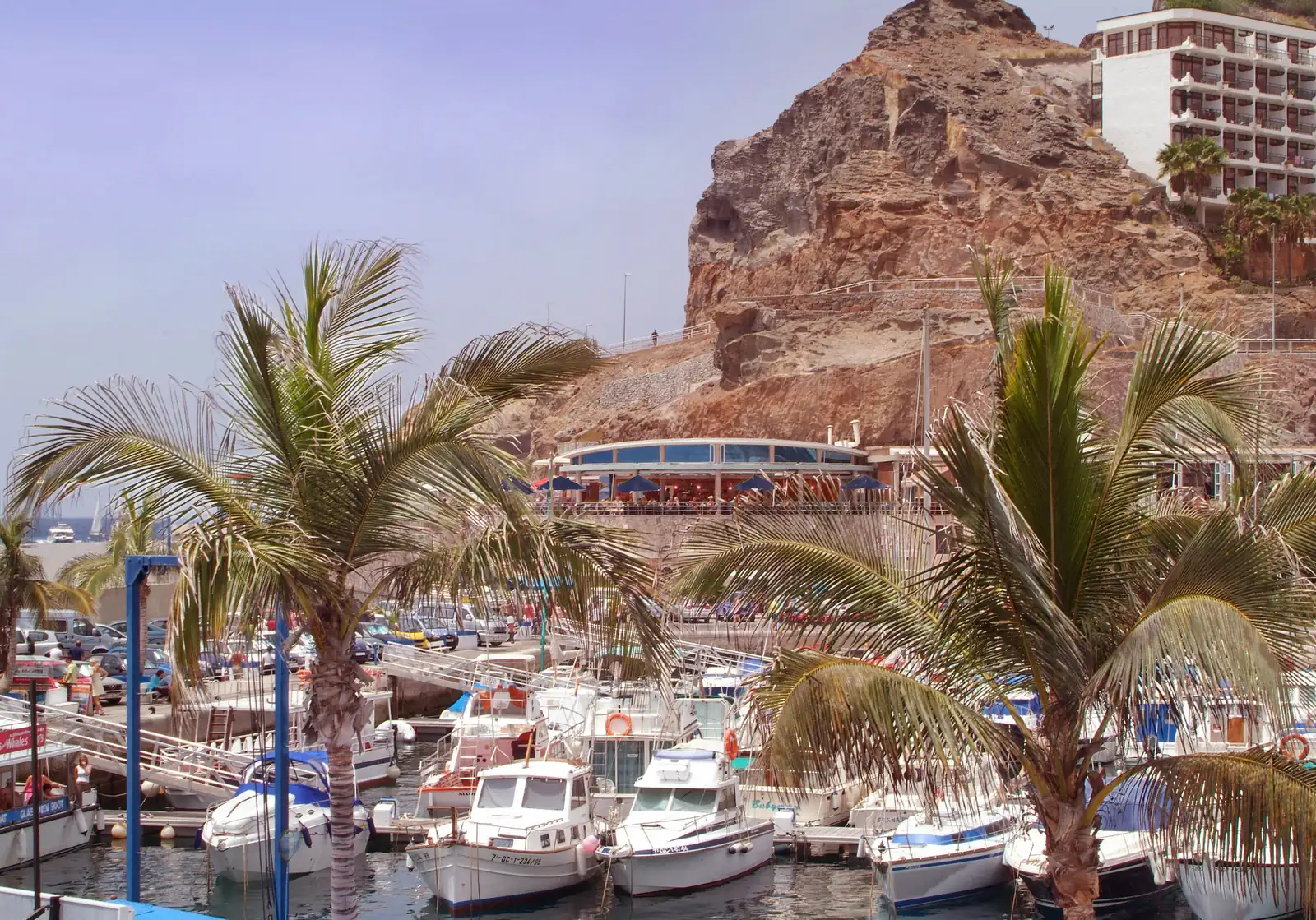
Sport-fishing boats sail from Puerto Rico, 7 km west of Arguineguín, and one resort-listed five-hour trip costs €80 with tackle, a sandwich and a drink included. Fishing from the shore or from your own boat needs a Canary Islands recreational fishing licence, valid for three years.
The place to book a sea-fishing trip is Puerto Rico, about 7 km west of Arguineguín. Mogán's tourism site describes Puerto Rico's marina as the nautical base for deep-sea fishing, and that is where the charter boats leave from. Arguineguín's own harbour is a working fishing port, and its fish is better eaten than caught: the Cofradía restaurant and fish counter sit right there.
The one rule that catches visitors out: recreational sea fishing in the Canaries needs a licence from the regional government. On a commercial trip the licence belongs to the boat, but if you want to fish from a rock, a pier or your own boat, you need your own.
Boat trips from Puerto Rico
Puerto Rico's two marinas, Puerto Escala and Puerto Base, together hold up to 530 berths, and the council's page lists excursions by sail or motor and deep-sea fishing among the services. The trips themselves are sold by private operators, many through resellers, and prices and itineraries change. We can give one concrete example from a source that publishes its prices.
The Anfi resort's activity catalogue lists a sport-fishing trip of five hours on the boat Cavalier from Puerto Rico, Monday to Saturday. Participants pay €80 and a spectator who comes along only to watch pays €65. Fishing material, a sandwich and one drink are included. The catalogue is written for Anfi guests, so check whether the same price applies if you are not staying there. Aggregator sites also list shared trips and private charters from Puerto Rico and Pasito Blanco; prices there vary by season and boat size, and private charters are priced per boat rather than per person.
When you compare offers, ask these questions:
- Is this bottom fishing, or trolling for bigger fish? The two are different days out.
- Is tackle included, and is there a minimum number of people?
- Does the boat hold the licence for group fishing? (See the next section.)
- What happens to the catch, and what is the policy on protected species?
- What is the cancellation rule if the sea is rough?
The licence: what the Canary Islands require
Recreational sea fishing is governed by the Canary Islands fishing regulation (Decreto 182/2004). The licence is personal, cannot be transferred, and must be carried with your ID. It lasts three years. There are three classes:
| Class | What it allows |
|---|---|
| 1st class | Fishing from a boat using surface trolling (curricán de superficie) |
| 2nd class | Underwater (spear) fishing; a medical certificate is required |
| 3rd class | Surface fishing from land, or from a boat without trolling: a rod from a pier, rock or beach |
For group recreational fishing from a boat operated as a business, the regional government says a collective first-class licence is required, and it is tied to the vessel, not the passenger. So on a licensed charter you normally do not buy your own, but ask the operator to confirm it covers you. Licences issued by the Spanish state or by another region are valid in the Canaries, provided you follow the Canarian rules.
Rod from the rocks needs a 3rd-class licence: the licence application goes through the regional government's electronic office or a citizen service office. The fee is revised each year and the regional pages do not state a figure, and how a visitor without a Spanish digital certificate obtains the licence is not explained. Allow time, and ask at the office before you pack a rod.
A young person needs a guardian's consent; there is no minimum age. The official pages are listed in the sources below.
Protected species: marlin, tuna and swordfish
Several of the fish that the sport-fishing boats advertise are under special protection. Catching bluefin tuna, albacore, bigeye tuna, swordfish, marlins and hake requires a separate authorisation from the Spanish agriculture ministry (MAPA), under Royal Decree 347/2011. If an operator promises marlin, ask how the authorisation works and whether the fish are released.
Fishing from the shore near Arguineguín
With a 3rd-class licence you can fish from land. Where you can do so legally in practice (harbour walls, working quays and bathing areas often have their own restrictions) is not covered by the regional licence pages, so ask at the harbour office or the town hall before choosing a spot, and never fish in a swimming area. Rough water breaking on the rocks is a safety problem in its own right; beach safety on the south coast explains the flag system.
Arguineguín's working harbour
Arguineguín is home to the largest fishing port on Gran Canaria, according to the council: 35 boats, 32 owners and 30 skippers, with up to 60 crew, rising to as many as 200 in the tuna season. The fishermen's cooperative runs a fish counter and a restaurant at the port. If you would rather taste the day's catch than reel it in, see the review of Cofradía de los Pescadores, the guide to fresh fish and local products, and the page on the fishing harbour. The port also takes leisure boats and passenger lines, and has 93 berths for vessels up to 20 m.
On Fiesta del Carmen in mid-July, the fishing boats are decorated for a sea procession; see the Fiesta del Carmen page.
Combine fishing with other days on the water
Not every boat day has to be a fishing day. The same coast offers dolphin and whale watching, catamaran and sailing trips, scuba diving and jet skis and other water sports. To get to Puerto Rico from Arguineguín you can take the passenger boat (Líneas Salmón lists €8 single, €14 return for adults) or the bus; details are in the boat guide and the bus guide.
Frequently asked questions
Do I need a licence to fish in Gran Canaria?
Yes, for recreational sea fishing on your own, from the shore or your own boat. It is issued by the Canary Islands government, is valid for three years and is personal. On a commercial charter a collective licence attached to the boat normally covers the group, but confirm with the operator.
Where can I go deep-sea fishing near Arguineguín?
The charters leave from Puerto Rico, about 7 km west of Arguineguín. Mogán's council describes the marina there as the base for deep-sea fishing, and operators also sail from Pasito Blanco.
How much does a fishing trip cost?
One listed five-hour sport-fishing trip from Puerto Rico costs €80 for a participant, with tackle, a sandwich and a drink included. Private charters are priced per boat and cost considerably more; check with each operator.
Can I fish from the shore in Arguineguín?
You need a 3rd-class licence. Local restrictions on harbour walls and bathing areas are not set out in the licence rules, so ask locally before fishing from a specific spot.
Which fish are protected?
Bluefin and bigeye tuna, albacore, swordfish, marlins and hake need a separate state authorisation under Royal Decree 347/2011. Ask your operator how it handles them.
Can children go on a fishing trip?
The licence rules set no minimum age; minors need a guardian's consent. The Anfi-listed trip is described for adults only, so ask operators about child places.
Sources
- Canary Islands government – recreational sea-fishing licences, classes, validity and protected species
- Canary Islands government – electronic office: applying for the licence
- Mogán tourism – Puerto Rico marina (Puerto Base): berths and deep-sea fishing base
- Mogán tourism – Cofradía de Arguineguín: fleet and crew numbers
- Mogán tourism – Arguineguín harbour: berths and services
- Anfi – activity catalogue for guests, including the five-hour sport-fishing trip
- Líneas Salmón – regular line and fares between Arguineguín, Anfi, Puerto Rico and Puerto de Mogán