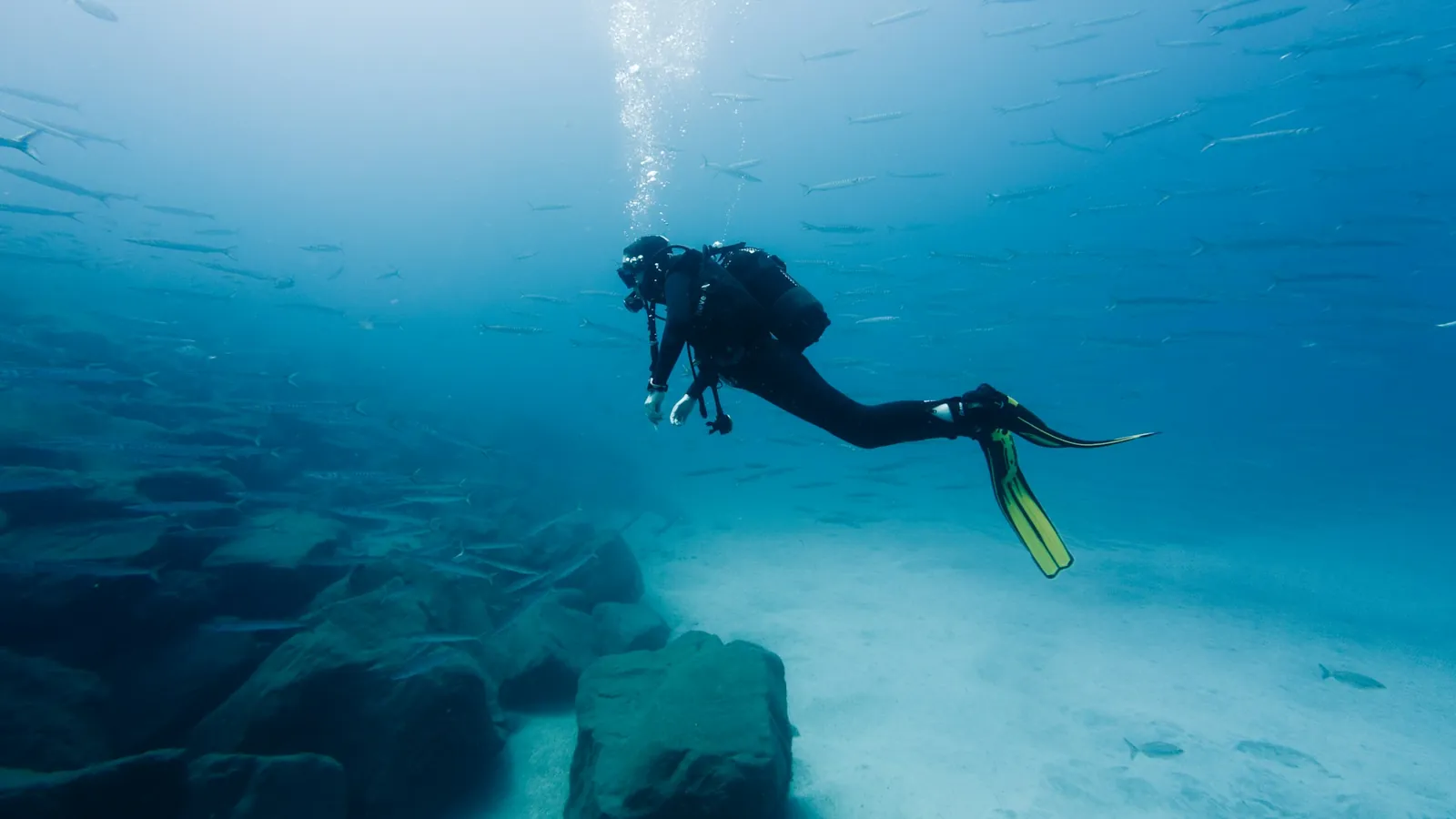
The dive centre in Arguineguín, Scuba Sur, takes small groups by boat from the Anfi marina to reefs and wrecks 12 to 33 metres deep, and a single boat dive costs €50 before equipment. The water runs from about 19 °C in late winter to about 24 °C in autumn, so you can dive all year.
You can dive from Arguineguín every day of the year. The local dive centre, Scuba Sur, runs boat dives from the Anfi marina, a short walk from its office, to a string of reefs and wrecks along the coast between Pasito Blanco and Puerto de Mogán. A single boat dive costs €50 before equipment, intro dives for people who have never dived are €79 from the beach or €99 from the boat, and the water stays between about 19 °C and 24 °C all year.
One thing to get straight at the start: the famous marine reserve of El Cabrón is at Arinaga on the east coast, roughly 30 km away as the crow flies. It is not a local dive site. The south-west coast has its own, quieter list, and that is what this page covers.
Where you dive from: the Anfi marina
Scuba Sur's boat, the Yolo-II, is moored in the Anfi marina at Anfi del Mar, between Arguineguín and Puerto Rico, and carries up to 10 divers. You register at the office, kit up, are given a locked box for your belongings and walk to the boat. The centre says it has about 30 documented sites within 30 minutes of the marina, and its teaching groups are limited to two students per instructor.
The marina itself is small (80 berths, according to Mogán's tourism site) and has a diving service among its facilities. If you are staying in Arguineguín, the walk to Anfi is part of the coastal walk to Patalavaca and Anfi, and the passenger boats between the two harbours are covered in the guide to boats from Arguineguín.
The boat-dive routine
Scuba Sur's published pattern is simple:
- Morning, certified divers only: leave the marina at 09:00 for a double dive with a surface interval of 45 to 60 minutes, back around 12:30 to 13:00.
- Afternoon, mixed group: certified divers, intro divers and snorkellers go together at 14:00 for shallow dives close to shore, back around 16:00.
- Night dives: on request.
Every boat dive follows the same limits: a maximum of 50 minutes, ending the dive at 50 bar of gas remaining, and no decompression dives, whichever limit comes first. Treat the times as the pattern, not a promise; the centre adapts to weather and numbers, and it does not take online bookings for dives starting within a couple of days, so message or call for short-notice slots.
The dive sites, with depths
These are the sites Scuba Sur regularly visits, with the depths and level the centre gives. Conditions change the day, so the skipper decides on the day.
| Site | Depth | Level | What it is |
|---|---|---|---|
| Bahia Lila | 5–15 m | All levels | The centre's house reef: rock, small caves and sand; used for training and intro dives |
| Arguineguín Reef | 12–16 m | Beginners and up | Long volcanic reef just outside the harbour, easy to navigate, good for drifts when the current allows |
| Magic II | 12–20 m | Open Water | Reef partly covered by the Anfi harbour wall; several routes, so 12 m-limited divers can do a full dive |
| Balito Deep | about 23 m | Advanced | Circular volcanic reef in front of Anfi, with an old drain pipe on its edge |
| Pasito Blanco natural reef | 17–19 m | Open Water | Large cigar-shaped rock on white sand in front of Pasito Blanco harbour |
| Artificial reef | 23 m | Advanced | Concrete structures placed by the University of Las Palmas de Gran Canaria in 1991 |
| Meteor wreck | 15–16 m | Open Water | A Russian hydrofoil that sank in 2003 near El Pajar, off the cement works; since broken up and covered in life |
| Sailboat wreck | about 33 m | Advanced | Sunken sailboat on white sand |
| Mogán wrecks (Cermona II and Alagranza) | 18–20 m | Certified divers | Two wrecks sunk deliberately in the mid-1990s and early 2000s, off Puerto de Mogán |
| Mogán caves | 10–15 m | Certified divers | Volcanic formations south-west of Puerto de Mogán |
A rival centre, Davy Jones Diving, gives slightly different depths for some of the same places (14–16 m for Arguineguín Reef, a Pasito Blanco reef about 2 km offshore with a maximum of 19 m). Differences of a couple of metres between operators are normal; go by your dive briefing.
What you will see
This coast is volcanic rock, sand and patches of seagrass rather than coral. Scuba Sur lists angel sharks, stingrays, barracuda, moray eels, octopus, cuttlefish and trumpetfish as regular sightings, and the EU-protected marine strip off Mogán is also home to loggerhead and green turtles, seahorses and shoals of salema and parrotfish. Wrecks and artificial reefs attract schools of fish; the reefs are where you find the morays and octopus. Visibility varies from day to day. Take a torch for the cracks and crevices.
Prices at Scuba Sur (2026 price list)
The centre's own list, checked in October 2026, gives these prices. Boat dives are quoted without equipment, so add hire if you need it.
| What | Price |
|---|---|
| Shore dive from Anfi beach, equipment included | €50 |
| Boat dives, equipment not included: 1 / 2 / 3 / 5 dives | €50 / €92 / €135 / €225 |
| Night dive | €72 |
| Refresher dive (required if you have not dived for two years) | €72 |
| Intro dive from the beach / from the boat | €79 / €99 |
| Snorkelling trip by boat | €45 |
| Open Water Diver course (SSI or PADI) | €450 |
| Advanced Open Water (SSI or PADI) | €350 |
| Diving insurance (Scubamedic): 1 day / 7 days / 1 month | €7 / €22 / €30 |
Resort activity lists, such as the Anfi catalogue for its guests, may show different figures for the same activity, so ask which price applies when you book.
Never dived? Intro dives, courses and snorkelling
An intro dive needs no licence and no theory. It takes about two hours, with roughly 25 minutes underwater and one instructor to one participant. From Anfi beach the minimum age is 8 (down to 3 m for 8 and 9 year olds, 6 m from age 10); the boat version, on the house reef at about 10 m, starts at 12.
The centre teaches both SSI and PADI courses. If you only want to look, the boat snorkelling trip leaves in the early afternoon with a guide in the water and all the gear provided. For snorkelling you can do on your own from the shore, see snorkelling around Arguineguín.
Rules, age limits and insurance
According to Scuba Sur's summary of the Spanish royal decree of 1 July 2020, the minimum age for recreational diving is 18, though training and excursions can be offered from 8, with depth limits of 6 m for ages 8–9, 12 m for 10–11, 21 m for 12–15 and 40 m for 16–17. Every diver must carry a dive computer, a cutting tool, a surface marker buoy and an audible signal, and the centre supplies whatever is missing. A medical sign-off is needed only if you have a known condition or cannot answer no to the standard questionnaire. The decree is official; check the current text if your plans depend on a detail.
Flying home after a dive day: your certification agency sets the minimum gap between your last dive and a flight, usually somewhere between 12 and 24 hours depending on how many dives you made. Ask the centre before you book your last dives.
The GHIC and EHIC cover state healthcare only, not private clinics, repatriation or most sea rescue, so a diving-specific policy is worth having; travel insurance, GHIC and EHIC explains what each covers. In an emergency, call 112.
Sea temperature and the best time to dive
There is no official buoy series for Arguineguín; the monthly figures below come from a secondary source covering southern Gran Canaria. Expect roughly 19 °C in February and March, 20 to 21 °C in May and December, about 22 °C in July and a peak of 23 to 24 °C from September to October. Scuba Sur itself gives 19 to 24 °C for the year.
The south coast sits in the lee of the island's mountains and is usually calmer than the north, which helps boat diving. Most visitors wear a wetsuit; hire is available at the centre. The warmest water and gentlest conditions are in autumn, but winter diving is good, too. For the wider climate picture, see weather and climate month by month.
Other options: the east coast and a day on the water
If the El Cabrón reserve is your goal, Davy Jones Diving is based there and says it is about 40 minutes from Puerto Rico. Expect a car or taxi journey of well over half an hour each way. Closer to home, Mogán's tourism site marks diving zones off Anfi, Tauro, Playa del Cura and Taurito. Puerto Rico's two marinas also list diving services. For more boat-based outings, see dolphin and whale watching, catamaran trips and fishing trips, or the rest of the water sports on offer.
Frequently asked questions
Can you scuba dive in Arguineguín?
Yes. Scuba Sur runs daily boat dives from the Anfi marina next to Arguineguín, plus shore dives from Anfi beach, courses and intro dives. Morning dives are for certified divers; the afternoon trip takes mixed groups.
How much does a dive cost in Gran Canaria's south-west?
At Scuba Sur a single boat dive is €50 without equipment, two dives are €92 and a beach shore dive with equipment is €50. An intro dive costs €79 from the beach or €99 from the boat. Prices are from the centre's list checked in October 2026.
Can a complete beginner dive?
Yes, with an intro dive: no licence or theory is needed, and the instructor stays with you one to one. The beach version is open from age 8 and the boat version from age 12.
What is the water temperature for diving?
Roughly 19 °C at its coolest in late winter to 23 or 24 °C in September and October. Scuba Sur quotes 19 to 24 °C for the year.
Is El Cabrón near Arguineguín?
No. El Cabrón is at Arinaga on the east coast, around 30 km away in a straight line and further by road. The local dives are reefs and wrecks off Arguineguín, Anfi, Pasito Blanco and Puerto de Mogán.
Do I need to bring my own gear?
No, but certified divers should bring their certification card and logbook. Equipment hire is available and boat dive prices exclude it, so ask for the hire cost when booking.
Sources
- Scuba Sur – daily boat dives: departure times, dive rules and dive sites with depths
- Scuba Sur – price list for dives, courses, snorkelling and insurance
- Scuba Sur – introduction dives: ages, depths and duration
- Scuba Sur – summary of the 2020 Spanish rules on recreational diving
- Davy Jones Diving – dive sites in Gran Canaria and the El Cabrón reserve
- Mogán tourism – Anfi marina facilities
- MITECO – the Franja marina de Mogán protected area and its species
- Temperatura do Mar – monthly sea temperatures for Gran Canaria (secondary source)