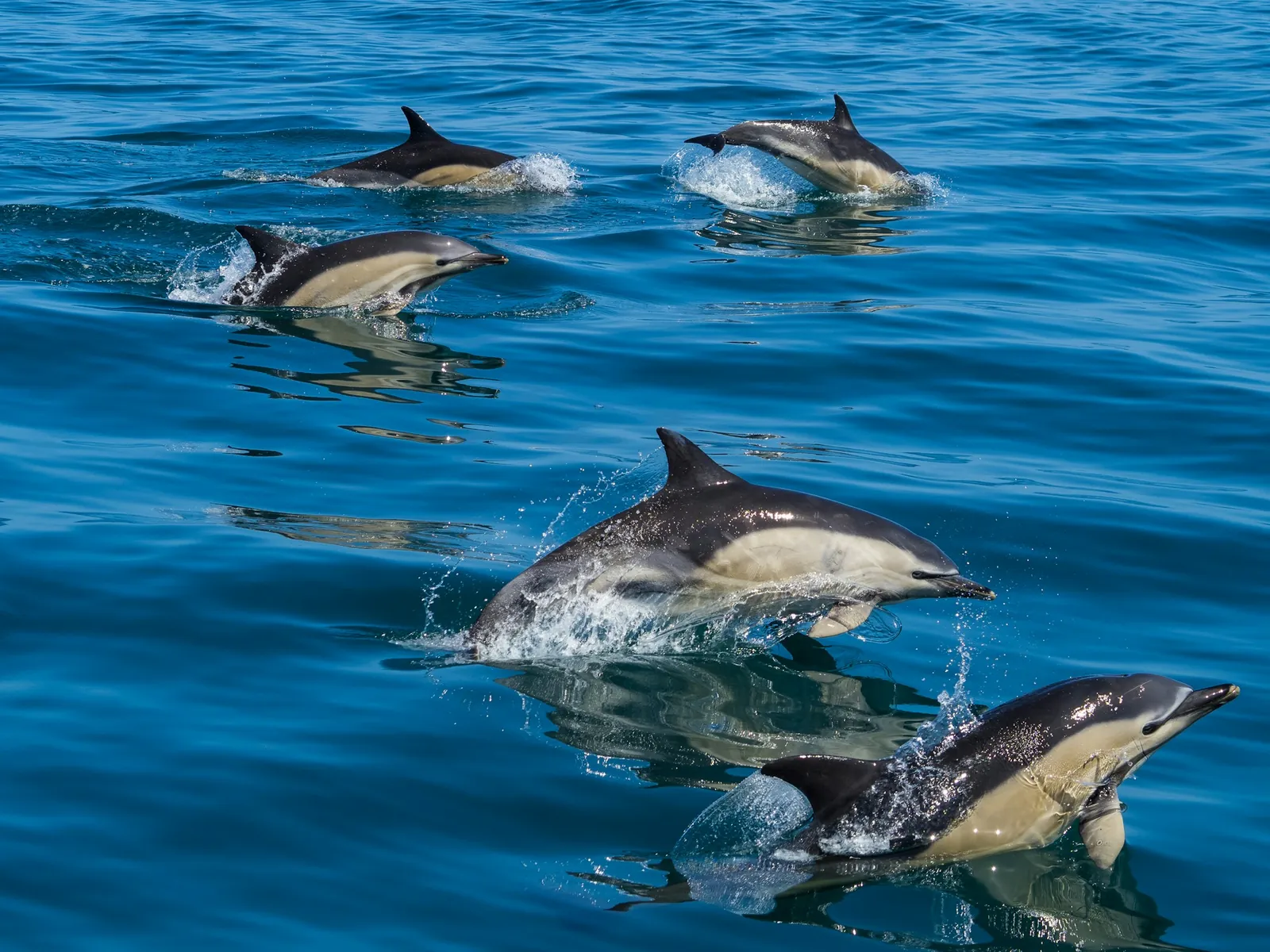
Líneas Salmón runs a two-hour dolphin trip from Arguineguín at 10:15 and 13:15 for €35 (children 6–12 €25). Bottlenose and common dolphins are the usual sightings, and the law limits how close boats may go.
The simplest way to see dolphins from Arguineguín is the two-hour excursion run by Líneas Salmón, which leaves from the town at 10:15 and 13:15 and costs €35 for adults and €25 for children aged 6 to 12; under-sixes go free (operator's page, checked October 2026). Other trips leave from Puerto Rico and Puerto de Mogán. Whatever you book, no operator can promise a sighting, and Spanish law sets firm rules for how close a boat may approach.
This page covers who sails, what you may see, when to go and how to tell a careful operator from a careless one. For the wider picture of harbours and routes, see boats from Arguineguín.
The dolphin trip from Arguineguín, at a glance
Líneas Salmón is a family business founded in 1969 that also runs the scheduled boat line along this coast. Its dolphin excursion sails off the south coast with a guide on board, and the same trip departs from four ports on a staggered timetable:
| Departure port | Morning | Afternoon |
|---|---|---|
| Puerto de Mogán | 09:45 | 12:45 |
| Arguineguín | 10:15 | 13:15 |
| Anfi del Mar | 10:30 | 13:30 |
| Puerto Rico | 10:45 | 13:45 |
The excursion lasts about two hours. Adults (13 and over) pay €35, children 6 to 12 pay €25, and babies aged 0 to 5 are free. A bus pick-up from the main hotels in the area is an optional extra of €4. The page does not state the season, so confirm that the trip runs on your dates. The operator's own site is lineassalmon.es, and its page for this trip is its "Dolphin excursion" page.
Other operators, and the price check
Another boat trip, Spirit of the Sea, a 97-seat two-deck catamaran with underwater windows, is listed on tour-booking sites as leaving from Puerto Rico and lasting around 2.5 hours. The operator's own site is not one we can point you to, and the booking platforms disagree about the length of trip and the price, with adult fares seen between roughly €25 and €46 depending on the platform. Treat those as indications only and check the price you are actually offered.
Whichever boat you choose, the questions in the section on choosing a responsible boat below apply, and booking on the operator's own site lets you see the terms yourself.
What you might see
The marine strip off Mogán is a protected European site (Natura 2000, "Franja marina de Mogán"), and the government's notes on it describe it as an important seasonal feeding and resting area for large and medium-sized cetaceans. The species named there are:
- Bottlenose dolphin (Tursiops truncatus), which lives in the Canaries all year in small groups
- Atlantic spotted dolphin (Stenella frontalis)
- Common dolphin (Delphinus delphis)
- Risso's dolphin (Grampus griseus)
- Fin whale (Balaenoptera physalus)
The same notes list loggerhead and green turtles. Líneas Salmón mentions bottlenose and common dolphins on its page. You will sometimes hear "calderones" on the boat: the Spanish word can mean Risso's dolphin or the short-finned pilot whale, so ask the guide which one they mean. Seeing a whale is a bonus rather than a plan.
When to go: season and time of day
There is no official calendar of the best months, and the operators do not publish a season for these trips. Bottlenose dolphins live here all year, so a trip in any month has a chance; the larger whales are described as seasonal visitors, with no dates given. A calm day makes the trip more comfortable and spotting easier; if the sea is rough, ask the operator whether the sailing will go ahead.
Two departures a day mean you can choose the morning for cooler air or the afternoon if you prefer a later start. Neither is promised to be better for sightings.
What the law says boats must do
Whale and dolphin watching in Spain is governed by Royal Decree 1727/2007, published in the Official State Gazette (BOE) in January 2008. In summary, as the decree reads:
- A protection zone of 500 m radius surrounds the animals. Within 60 m the boat must not enter or stay: engine in neutral or stopped, and no propeller started while animals are nearer than 60 m. If dolphins approach the boat on their own, it may continue at its speed and course.
- Between 60 m and 300 m, no more than two boats at a time. Approaching a lone adult with a calf, or lone calves, is prohibited in this band.
- Approach at a constant speed of no more than 4 knots, at about 30 degrees, never from in front, behind or at right angles; do not circle the animals or reverse towards them.
- Prohibited: touching or feeding them, cutting through a group, separating a mother and calf, making noise to attract them, and swimming or diving within 60 m.
The Guardia Civil's maritime service, the Navy and the Merchant Marine enforce the rules, and breaches are sanctioned under Law 42/2007. Injured or dead animals should be reported to the Guardia Civil or Salvamento Marítimo. Some websites mention a 15-minute limit on the time a boat may stay with the animals, but that limit is not in the national decree, so do not quote it.
Swimming with dolphins is not allowed. Under the Spanish decree, no one may swim or dive within 60 m of whales or dolphins. A trip that offers to put you in the water with them is breaking the rule. A swim stop for the passengers, away from the animals, is a different thing.
How to choose a responsible boat
You do not need to be an expert to tell a careful trip from a pushy one. Look for these signs on the day:
- The skipper slows down well before the animals and does not chase them or cut across the group.
- Only one or two boats are near the animals, and the others wait.
- The guide explains the rules, names the species and does not encourage passengers to call or splash to attract them.
- Nobody is invited into the water near the animals.
Be wary of anyone who sells a "guaranteed sighting" without saying what happens if there is none. Líneas Salmón's page uses that wording; read the booking terms for what the guarantee means. Wild animals cannot be guaranteed, and a boat that tries too hard to make good on a promise is the one most likely to push the rules.
What to bring and how to cope with the sea
Bring a hat, sun cream and a windproof layer, since it is cooler and breezier out at sea than on the quay. If you are prone to seasickness, take a remedy before boarding as the swell can be noticeable, and sit towards the middle of the boat. Children aged 6 to 12 have their own fare, and the family side of boat trips is covered in Arguineguín with kids. Other boat trips from the same ports are covered in catamaran and sailing trips, and fishing trips are in fishing trips and sea fishing. If the idea of going under the water appeals more, see scuba diving near Arguineguín and jet ski, parasailing and other water sports.
Reaching the boat is simple: the quay is in the town, and Global's buses stop in Arguineguín (buses in and from Arguineguín). If you are staying in Puerto de Mogán, Anfi or Puerto Rico, the same excursion leaves from those ports too.
Frequently asked questions
How much is a dolphin watching trip from Arguineguín?
Líneas Salmón charges €35 for adults, €25 for children aged 6 to 12 and nothing for under-sixes (operator's page, checked October 2026). A hotel bus pick-up is €4 extra. Other operators' prices vary.
How long is the trip?
The Líneas Salmón excursion lasts about two hours. Trips on other boats can run to 2.5 or 3 hours, according to booking platforms that disagree with each other.
Which dolphins and whales live off Arguineguín?
The protected marine strip off Mogán lists bottlenose, Atlantic spotted, common and Risso's dolphins and the fin whale, plus loggerhead and green turtles. Bottlenose dolphins stay all year.
Can you swim with dolphins in Gran Canaria?
No. Spanish law forbids swimming or diving within 60 m of whales and dolphins, and boats must follow strict approach rules, including a maximum of two boats at a time.
What is the best time of year for whale watching here?
No official calendar exists, and the operators do not publish a season. Bottlenose dolphins are present all year, while larger whales are described only as seasonal visitors.
Sources
- Líneas Salmón – dolphin excursion: ports, times and prices
- BOE – Real Decreto 1727/2007, protection of cetaceans (articles 2, 4 and annex II)
- MITECO – Franja marina de Mogán (ES7010017), species and habitat
- Líneas Salmón – regular line (the same ports)
- Civitatis – dolphin and whale watching from Puerto Rico (reseller listing)