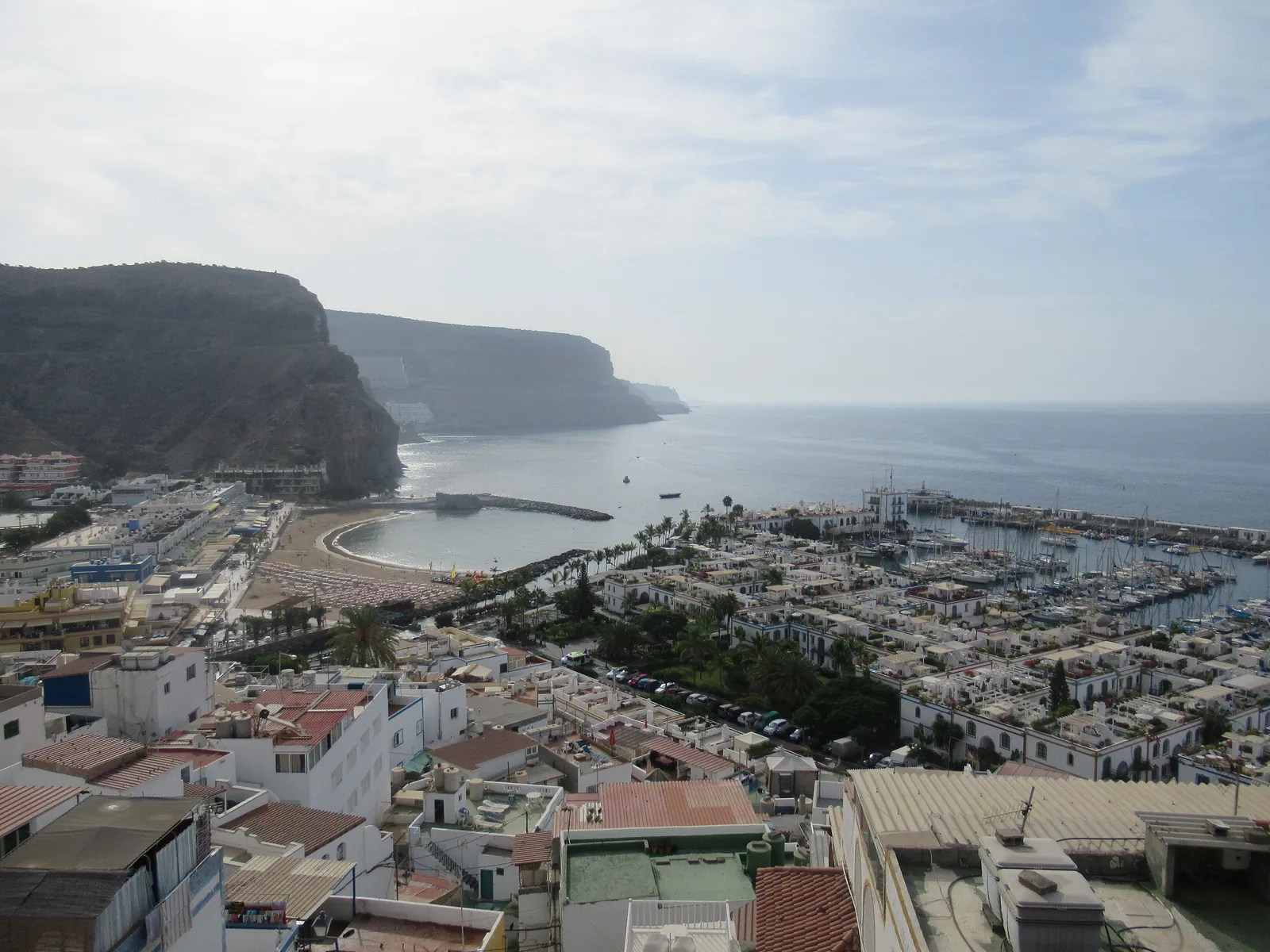
Playa de Patalavaca is a 303 m beach of dark sand and boulders with calm water, toilets, showers, a lifeguard and sunbed hire, a short bus ride or walk from Arguineguín. It has no Blue Flag.
Patalavaca beach (Playa de Patalavaca on the official list) is about 303 metres of dark sand mixed with boulders, with calm water, between Arguineguín and Anfi del Mar. Mogán council's tourism page lists toilets, showers, a lifeguard, sunbed hire and step-free access, and describes many restaurants around it. It is a swimming-and-lunch beach rather than a lie-on-pale-sand beach, and it is easy to reach from Arguineguín on foot, by bus or by taxi.
This page is about the beach itself. For the neighbourhood behind it (hotels, apartments, shops), see Patalavaca.
The sand and the sea: what to expect underfoot
The council describes the sand as dark (arena oscura) with boulders. In practice that means volcanic sand and rock, not the pale sand of Anfi's beach a little further on. The sand is warm in the sun and darker colours absorb more heat, so shoes for the walk from the towel to the water are a sensible idea at midday in summer. The boulders are part of the beach, and you may meet them at the water's edge or just under the surface, so go in slowly the first time.
The council classes the water as calm. That describes the setting in general: this is a sheltered stretch of the south-west coast, not a surf beach. It does not remove the need to look at the flag on the day, which is the real guide (see the safety section below).
Facilities: what is listed
From the official Mogán tourism page for the beach:
- toilets and showers;
- a lifeguard (season and hours are not published; see below);
- sunbed hire;
- accessible, according to the council's icons;
- many restaurants nearby.
The page's description also advertises online sunbed booking through the council's system. Current prices are not listed here. If you want a sunbed on a busy day, check the council's page for the beach before you go and ask at the stand when you arrive.
For wider access questions (ramps, beach mats, toilets, adapted showers), see accessible Arguineguín. Do not count on a particular piece of equipment being out on a given day.
Patalavaca beach next to its neighbours
The council's lengths and descriptions make a quick comparison along this stretch of coast possible:
| Beach | Length | Sand | Water | Lifeguard listed |
|---|---|---|---|---|
| Perchel de Arguineguín (town beach) | 220 m | Golden and black sand | Calm, with an intertidal pool | No |
| Las Marañuelas (Arguineguín) | 279 m | Dark sand | Calm | Yes |
| Patalavaca | 303 m | Dark sand and boulders | Calm | Yes |
| Anfi | 180 m | Golden sand and boulders | Calm | Yes |
So Patalavaca is the longest of the four and the one with the most restaurants listed around it. If you want pale sand, Anfi del Mar beach is the next one along. If you want to be in the town, Arguineguín town beach has the intertidal pool. For a much smaller beach (55 m on the council list), see Costa Alegre. The wider comparison is in the best beaches near Arguineguín.
Swimming, flags and the lifeguard
No beach in Mogán holds a Blue Flag for 2026–27; the only Blue Flags in the municipality are for the marinas. That includes Patalavaca. If you see an older page calling it a Blue Flag beach, it is out of date.
The council's page shows a lifeguard but does not give a season or hours, so do not plan around a particular time. Check the flag when you arrive: the UK Foreign Office's advice is that a red flag means do not enter the water, that many Spanish beaches use a flag system, and that you should take extra care where there are no lifeguards, flags or signs. Strong undercurrents around Spanish islands are another point it makes. The island-wide rules are in beach safety on the south coast.
If you are stung. Ask the lifeguard or call 112. NHS advice for jellyfish and similar stings: rinse with seawater (not fresh water), remove spines or tentacles with tweezers or the edge of a bank card, and soak the area in water as hot as you can bear for at least 30 minutes. Do not use ice and do not urinate on the sting. Portuguese man o' war do turn up in the Canaries from time to time, and stranded ones can still sting.
Water temperature through the year
Sea temperature data for Patalavaca itself does not exist as an official series. The figures below are island-wide monthly averages from a secondary source, spanning several south-coast and northern locations, so read them as a guide and not a measurement:
| Months | Average sea temperature |
|---|---|
| February–March (coldest) | about 19 °C |
| April–May | about 19–20.5 °C |
| June–July | about 21–22 °C |
| August | about 23 °C |
| September–October (warmest) | about 23.5 °C |
| November–December | about 21–22.5 °C |
In other words, the sea is swimmable all year for most people but never really warm in winter. For air temperatures and sunshine, see the weather guides linked from Arguineguín in winter.
Sun, shade and wind
The Canary Islands health authority describes the Canaries as the Spanish region with the highest UV level all year, and its notice of 30 July 2026 put most Gran Canaria municipalities at "extremely high" for a few days. The advice at very high levels is SPF 50+, shade in the middle of the day, a hat, sunglasses and covering arms and legs, with extra care for children and older people. Cloud or a breeze do not remove the risk. More is in sun, heat and UV on Gran Canaria.
There is no official figure for natural shade on this beach. Bring your own hat and a shirt, and treat any shade you find as a bonus. Calima, the Saharan dust haze, is most frequent from December to March according to the Spanish weather service AEMET and can make the air hazy and the sun look flat; see calima.
How busy does it get?
There are no official crowd figures for Patalavaca. The council gives an occupancy rating for some beaches (it calls Amadores "medium") but not for this one. The general rule for any south-coast beach applies: mornings are quietest, school holidays and bank holidays are busiest, and sunbeds go first on sunny weekends. No one can give you a number of people per hundred metres, and you should be wary of anyone who does.
Getting to Patalavaca beach
On foot. The coastal path between Arguineguín and Patalavaca is a stroll rather than a hike. Allow roughly half an hour at an easy pace from the middle of Arguineguín, longer with children; some sections have steps. The route, with stops for a swim, is described in coastal walks to Patalavaca and Anfi.
By bus. Global's lines 91, 33 and 39 call at Patalavaca, and line 91 has a stop called "Patalavaca" on its page. Lines and times are in buses in and from Arguineguín. The exact position of the stop relative to the sand is not published, so ask the driver.
By taxi or car. A taxi from the centre of Arguineguín is a short hop. If you bring a car, see parking in Arguineguín and taxis; parking charges and spaces at the beach itself are not published.
Eating and drinking by the beach
The council lists many restaurants on and around the beach. Individual opening hours are not published, so none are given here. Look at the menu and prices before you sit down. For Anfi's own beach clubs and the resort behind it, see Anfi del Mar.
A simple plan for a Patalavaca beach day
- Arrive in the morning, when the beach is quietest and the sun is lower.
- Check the flag and where the lifeguard is before the first swim.
- Take water, a hat and high-factor sun cream; the UV level here is high all year.
- Have lunch at one of the restaurants around the beach.
- Walk on to Anfi in the late afternoon, or walk back towards Arguineguín for dinner.
Frequently asked questions
Is Patalavaca beach good for swimming?
The council describes the water as calm, and the beach has a lifeguard, toilets and showers. Check the flag on the day: a red flag means do not enter the water.
Does Patalavaca beach have a Blue Flag?
No. No beach in the municipality of Mogán has a Blue Flag for 2026–27; only the marinas at Puerto de Mogán and Pasito Blanco do.
Is Patalavaca beach sandy?
It is dark sand mixed with boulders, not pale imported sand. Anfi, the next beach along, has golden sand.
Can you rent sunbeds at Patalavaca beach?
Yes, the council lists sunbed hire on the beach and its page promotes online booking. Current prices are not published, so ask at the stand or look at the council's page.
How far is Patalavaca beach from Arguineguín?
Roughly half an hour on foot along the coast path at an easy pace. You can also take Global's lines 91, 33 or 39, or a short taxi ride.
Is Patalavaca beach accessible for wheelchair users?
The council's page marks the beach as accessible. For equipment on the day, such as beach mats, check on arrival or ask the lifeguard.
Sources
- Mogán tourism – Playa de Patalavaca: length, sand and services
- Mogán tourism – Playa Perchel de Arguineguín
- Mogán tourism – Playa de las Marañuelas
- Mogán tourism – Playa de Anfi
- Blue Flag (ADEAC) – 2026 list of awarded beaches
- GOV.UK – Spain travel advice: safety, swimming and flags
- NHS – jellyfish and other sea creature stings
- Government of the Canary Islands – public health notice on UV, 30 July 2026