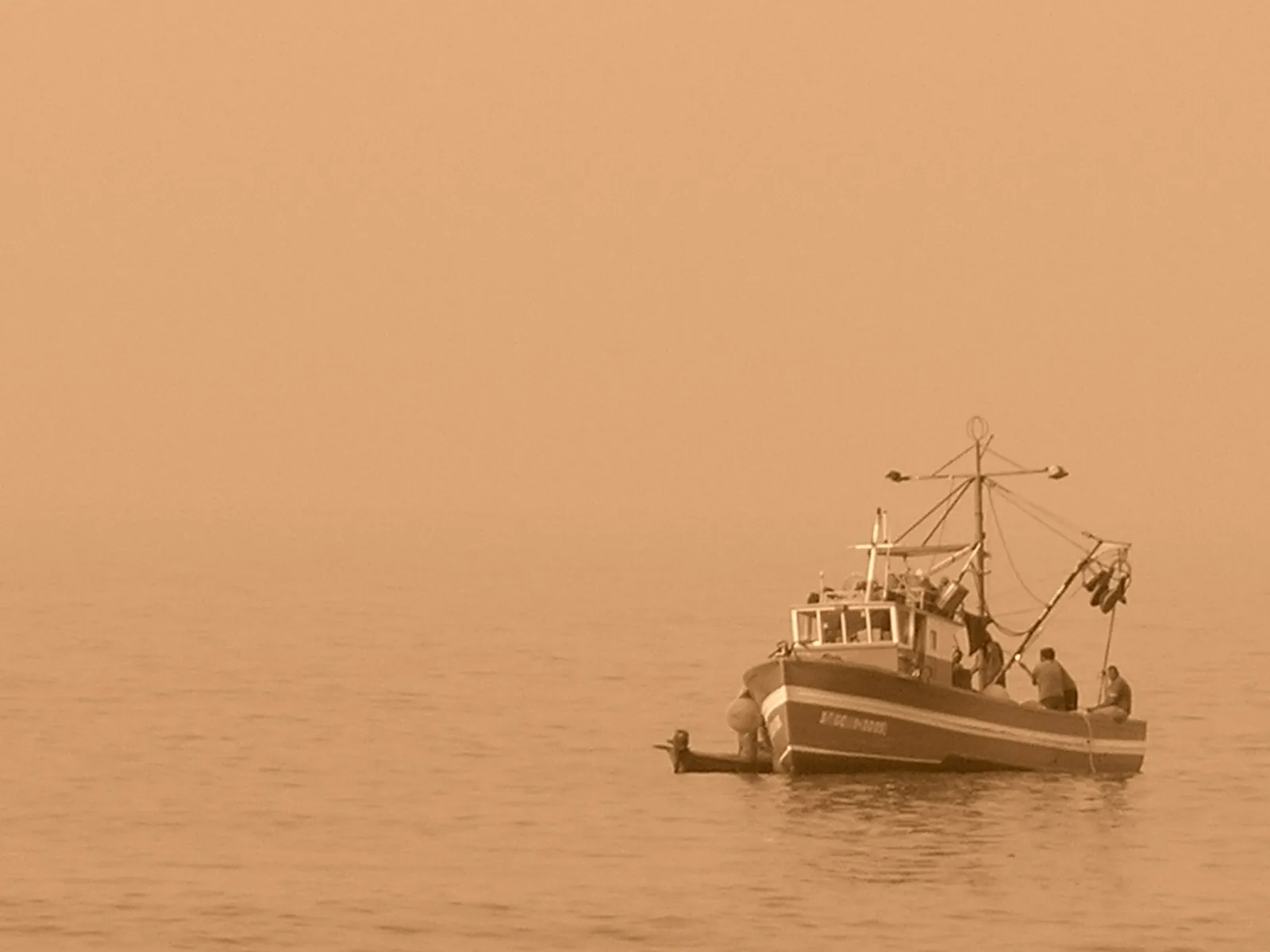
Calima is Saharan dust suspended in the air, most often between December and March. It hazes the sky for a few days, can irritate lungs, and now and then disrupts flights.
Calima is fine desert dust blown from the Sahara and held in the air over the islands. It turns a blue sky white-grey, cuts visibility and leaves a film on terrace tables and car windscreens. On Gran Canaria it is most frequent in winter, from December to March according to Spain's weather agency AEMET, though it can also come with summer heatwaves. For most visitors it is a nuisance of a day or two. For people with asthma, COPD or other lung conditions, the Canary health authority advises taking it seriously.
This page covers what calima is, when it is likely, what the health authority recommends, and how it affects flights. It does not cover the weather in general, which the month-by-month climate guide handles.
What calima actually is
The word means dust in suspension, and the Spanish usage is wider than "haze". It describes air loaded with mineral dust from the Sahara, blown towards the islands on easterly winds. The dust is what gives the sky its yellow or grey cast, and it is why the mountains can disappear. AEMET issues weather warnings for it, and in recent episodes a yellow warning has been tied to visibility of about 3,000 metres.
It is not fog, and it is not smoke. A calima day can feel dry, with the sun reduced to a pale disc, and the surfaces outdoors pick up fine reddish-brown dust. Whether it feels hot or cool depends on the episode, and there are no published figures on that.
When it happens
AEMET's delegate in the Canaries said in 2023 that the winter season, December to March, is the period of dust episodes. There is no official month-by-month calendar for calima. His statement added that the number of days with dense calima has fallen over the past 40 years, although several winters since 2020 have been marked by desert dust slightly above normal. Other sources disagree on the trend, so take it as "no safe month, no reliable forecast far ahead".
In practice that means a winter holiday has a real chance of a calima episode. If your trip is short and fixed, it is a risk worth knowing about but not one to cancel for. The winter sun page puts it in the context of the other cold-season weather.
Health advice
This is information, not medical advice. Check with your own doctor if you have a lung or heart condition.
The Canary Islands health authority (Dirección General de Salud Pública) advises, as reported in the Canary press:
- limit time outdoors and avoid physical exertion outside;
- keep windows closed;
- people with chronic respiratory disease should have their medication to hand;
- take extra care with children and older people.
The dust can worsen asthma and COPD and cause chest discomfort, coughing and palpitations for up to five days after an episode begins, according to the same advice. If symptoms are serious, call 112. For the clinics, pharmacies and private hospitals that serve the area, see the health and medical services guide. The Arguineguín health centre is on Calle Damasco, but check current urgent-care hours before relying on them.
Calima and your inhaler. If you rely on a reliever inhaler or other lung medication, pack more than you expect to need, keep it in your hand luggage and carry a copy of the prescription. A calima episode is a bad day to discover the box at the bottom of the case is empty.
Effect on flights
Calima can reduce visibility at airports, and Aena and airlines adjust when it does. During a dust episode on 31 March 2026, Aena counted three diversions and seven cancellations in the Canaries, mostly short inter-island flights involving Tenerife Norte, La Palma and La Gomera, with some touching Gran Canaria. A flight from Gran Canaria to El Hierro was among the cancellations and another from Gran Canaria was diverted to Tenerife Sur. Aena's advice was to check your flight status before travelling to the airport.
That is a snapshot, not a rate. If you are flying on or off the island in winter, check the airline's status page the morning of travel, leave slack in connections, and read the flights page for the general picture. If you are booked on a flight that is cancelled, your rights depend on the airline and the ticket; the airline's own page is the place to start.
Ordinary precautions on the ground
- Close windows and balcony doors during an episode.
- Wear sunglasses in the open if the dust irritates your eyes.
- Postpone strenuous plans, such as a hike or a long bike ride, to a clear day. The coastal walks are better in clear air.
- Wipe sunbeds and outdoor furniture before using them.
- Sun protection still matters: the Canaries have Spain's highest UV levels all year, and the sun and heat page covers it.
A dusty day is not wasted. It is a good day for the Tuesday market if it falls on one, or a long lunch indoors; the rainy and windy day ideas work for a hazy day too.
Frequently asked questions
What is calima in Gran Canaria?
Calima is Saharan dust held in the air, which turns the sky hazy and cuts visibility. It is most common from December to March.
When is calima most likely in Gran Canaria?
AEMET says winter, December to March, is the main season for dust episodes, although calima can also occur in summer during heatwaves. There is no official month-by-month statistic.
Is calima dangerous?
For most healthy people it is an irritation. The Canary health authority advises limiting time outdoors, keeping windows closed and avoiding outdoor exertion, and warns that it can worsen asthma and COPD. If you have a lung condition, ask your doctor, and call 112 in an emergency.
Does calima cancel flights?
Occasionally it causes delays, diversions or cancellations, mostly on short inter-island routes. Check your flight status before leaving for the airport.
How long does a calima episode last?
Episodes vary and there is no verified average. The health authority notes that effects such as coughing and chest discomfort can persist for up to five days after an episode begins.
Can I still go to the beach during calima?
You can, but the air is poor for exertion and the sun is still strong through the haze. Limit time outdoors if you are sensitive, and keep an eye on the flag for sea conditions.
Sources
- RTVC: AEMET's delegate on calima and the dust season
- Diario de Avisos: health recommendations for calima (February 2026)
- RTVC: AEMET warnings and visibility during a calima episode
- Diario de Avisos: flights cancelled and diverted by calima (March 2026)
- Government of the Canary Islands: UV radiation warning