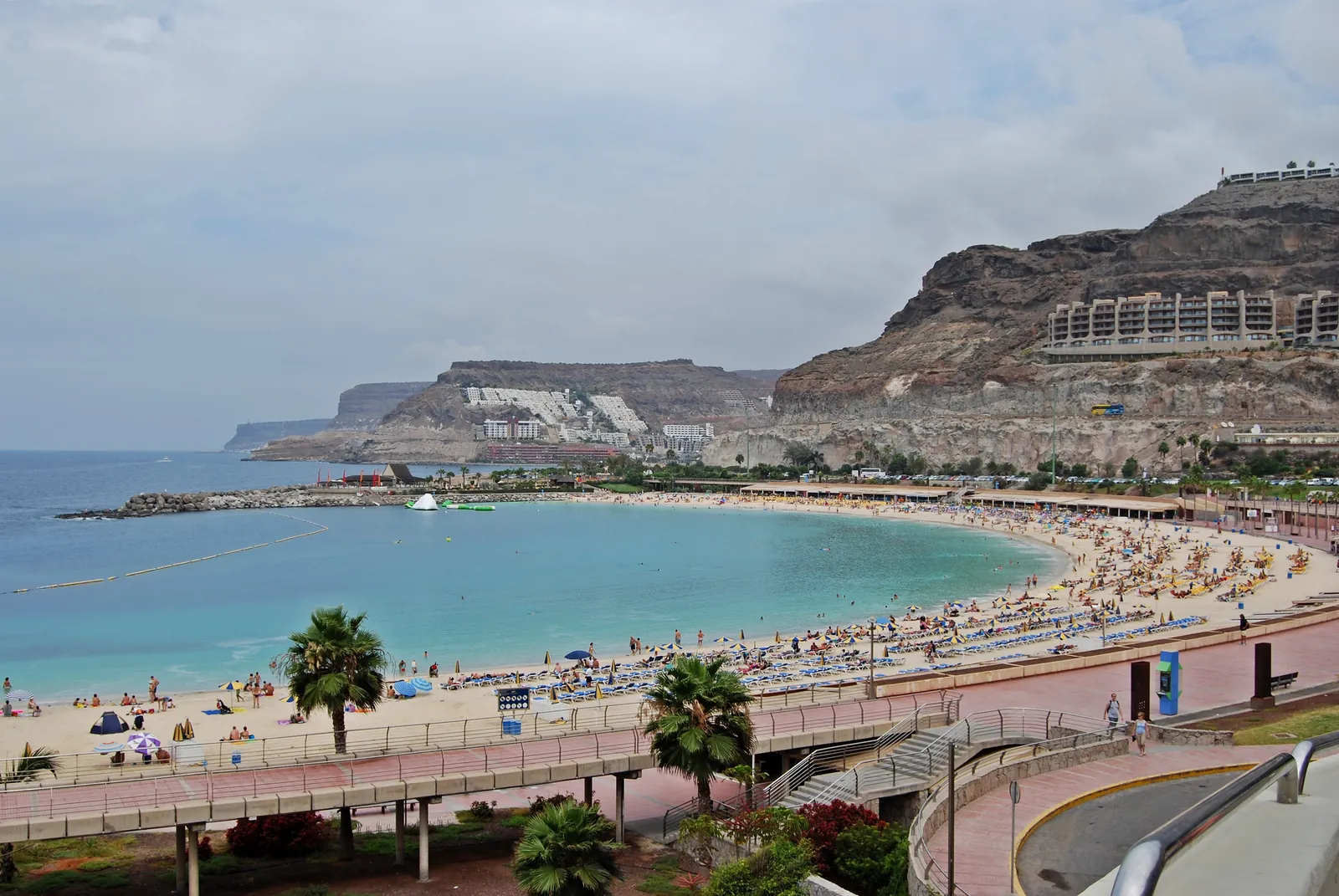
For an easy swim with facilities, start with Marañuelas, Patalavaca or Anfi; for the longest sand, Amadores; for a lively resort beach, Puerto Rico. Tauro, Cura and Taurito are more exposed.
There is no single best beach near Arguineguín; there is a best beach for the day you have in mind. For an easy swim with a lifeguard, toilets and a bar nearby, the beaches along the coast to the west of the town (Las Marañuelas, Patalavaca and Anfi) do the job. For the longest stretch of pale sand, go on to Amadores. For a busy resort beach with water sports, Puerto Rico. For somewhere with a little more swell and a bit of snorkelling, Tauro, Playa del Cura and Taurito.
Everything below uses the beach descriptions on Mogán council's tourism site (checked October 2026), which give length, sand, water conditions and listed services. They do not measure how pleasant a beach is on a given Saturday, so we add what the facts imply. The nearest of the group, Puerto Rico, is about 7 km from Arguineguín by road and Puerto de Mogán about 16 km (roughly 21 minutes without traffic), so everything here fits inside a half-hour trip.
The beaches side by side
Mogán lists 22 beaches along about 16 km of coast. These are the ones most visitors to Arguineguín actually use, from east to west:
| Beach | Length | Sand | Water (council) | Lifeguard listed | Notes |
|---|---|---|---|---|---|
| Perchel de Arguineguín | 220 m | Golden and black | Calm | No | Intertidal pool, playground, step-free |
| Las Marañuelas | 279 m | Dark | Calm | Yes | Sunbeds, water-sports hire |
| Costa Alegre | 55 m | Sand and gravel | Calm, breakwater | Yes | Small, medium occupancy |
| Patalavaca | 303 m | Dark sand, boulders | Calm | Yes | Many restaurants |
| Anfi | 180 m | Golden sand, boulders | Calm | Yes | Marked diving/snorkelling zone |
| Amadores | 488 m | White | Calm | Yes | 50 m wide, medium occupancy |
| Puerto Rico | 284 m | Golden, boulders | Calm | Yes | Water sports, step-free |
| Tauro | 440 m | Sand, gravel, boulders | Moderate swell | No | Restaurants, diving zone |
| Playa del Cura | 193 m | Boulders and dark sand | Moderate swell | No | Step-free, diving zone |
| Taurito | 160 m | Black | Moderate; care in heavy swell | Yes | Diving zone |
| Puerto de Mogán | 209 m | Golden | Calm | Yes | Fully step-free |
"Lifeguard listed" means the council's page shows the service; it does not publish seasons or hours (see beach safety on the south coast). None of these beaches has a Blue Flag for 2026–27, although the marinas at Puerto de Mogán and Pasito Blanco do.
For a first swim straight from Arguineguín
Start with the town's own beaches. Arguineguín town beach (Perchel) has the intertidal pool, a children's playground and an adapted shower, but the council shows no lifeguard there. Las Marañuelas is the next one along, with a lifeguard, sunbed hire and bars nearby. Both are a short walk from the centre and neither needs a bus. The much smaller Costa Alegre is a 55 m pocket protected by an artificial breakwater.
For a beach day with lunch: Patalavaca and Anfi
Walk or bus on and you reach Patalavaca, the longest of the Arguineguín-side beaches at 303 m and the one with the most restaurants listed around it. Its sand is dark and mixed with boulders. A little further on, Anfi del Mar beach (officially Playa de Anfi, 180 m) has golden sand, a lifeguard and a diving zone, with the resort behind it. Our coastal walks to Patalavaca and Anfi link the three on foot, so you can swim at one and have lunch at another.
These are calm-water beaches by the council's own description, which is why they suit most people. They are still open Atlantic: look at the flag every time.
For the longest sand: Amadores
Amadores is 488 m long and 50 m wide with white sand, calm water, a lifeguard and sunbed hire; the council rates the occupancy as medium. That width is the point: there is room to spread out in a way the short beaches cannot offer. It is in the Puerto Rico area, further along than Anfi, so allow time for the road or the bus; the bus guide has the lines.
For water sports and people-watching: Puerto Rico
Puerto Rico beach is 284 m of golden sand and boulders with calm water, nautical hire and a lifeguard. It is step-free according to the council. It is the busiest-feeling beach on this list because the resort is built around it.
For a bit more swell and clearer water: Tauro, Cura and Taurito
West of Puerto Rico the coast is more exposed. Playa de Tauro is 440 m of sand, gravel and boulders at the mouth of the Tauro ravine; the council describes moderate swell and lists restaurants and a diving zone, but no lifeguard. Playa del Cura (193 m) also lists moderate swell, no lifeguard, and a diving zone. Taurito (160 m, black sand) has a lifeguard, but the council warns to take extreme care when there is a ground swell. Choose these for snorkelling days and confident swimmers; see snorkelling around Arguineguín. The same listings are why we do not put them first for toddlers (see family-friendly beaches).
For a prettier harbour setting: Puerto de Mogán
The beach at Puerto de Mogán is 209 m of golden sand with calm water, a lifeguard and full step-free access per the council. It is the furthest on this list (about 16 km by road) and the one where the town, rather than the sand, is the draw: the harbour village has plenty to see. The boat from Arguineguín is an alternative to the road.
Which beach for which day
- Short stroll, no plans: Perchel or Las Marañuelas.
- Swim then lunch: Patalavaca.
- Pale sand without a long trip: Anfi.
- Space to spread out: Amadores.
- Water sports and nautical hire: Puerto Rico.
- Snorkel: Anfi on a calm day; Cura, Tauro or Taurito when the sea is gentle.
- Escape the crowds: see quiet beaches and small coves.
Ranking by crowds. The council gives occupancy for only a few beaches (Amadores and Costa Alegre are "medium"). For the rest there is no official figure, so the practical rule is early morning, outside school holidays, and a weekday rather than a Sunday.
Sand, shade and sea temperature
The sand along this coast runs from dark volcanic sand at Patalavaca and Las Marañuelas to golden at Anfi and white at Amadores, so the colour changes within a few kilometres. Natural shade is not documented for any of these beaches; bring a hat and use hire parasols. The sea averages roughly 19–20 °C from February to April and reaches about 23–24 °C in September and October, based on a secondary monthly series for Gran Canaria rather than a local measurement. Sun advice is in sun, heat and UV on Gran Canaria.
Frequently asked questions
What is the best beach near Arguineguín?
For most visitors it is Patalavaca or Anfi: calm water, a lifeguard, toilets and showers, and restaurants close by. If you want the longest sand, Amadores at 488 m is the better pick.
Does Arguineguín have a good beach?
The town has a small, sheltered beach with an intertidal pool (Perchel) and a second one at Las Marañuelas. They are practical rather than spectacular, and better-known beaches are a short walk or bus ride away.
Which beaches near Arguineguín have a Blue Flag?
None. No beach in Mogán holds a Blue Flag for 2026–27. Only the marinas at Puerto de Mogán and Pasito Blanco do.
Which is the nearest sandy beach to Arguineguín?
The town's own beaches have golden-and-black or dark sand. The nearest golden sand is at Anfi del Mar, a short walk or drive along the coast.
Can I walk between the beaches?
Yes, between Arguineguín, Patalavaca and Anfi there is a coastal path. Allow roughly half an hour between the town and Patalavaca at an easy pace.
Are the beaches near Arguineguín safe for swimming?
Most listed beaches have calm water and a lifeguard, but conditions change. Follow the flag, and take extra care at Tauro, Playa del Cura and Taurito, where the council lists moderate swell.