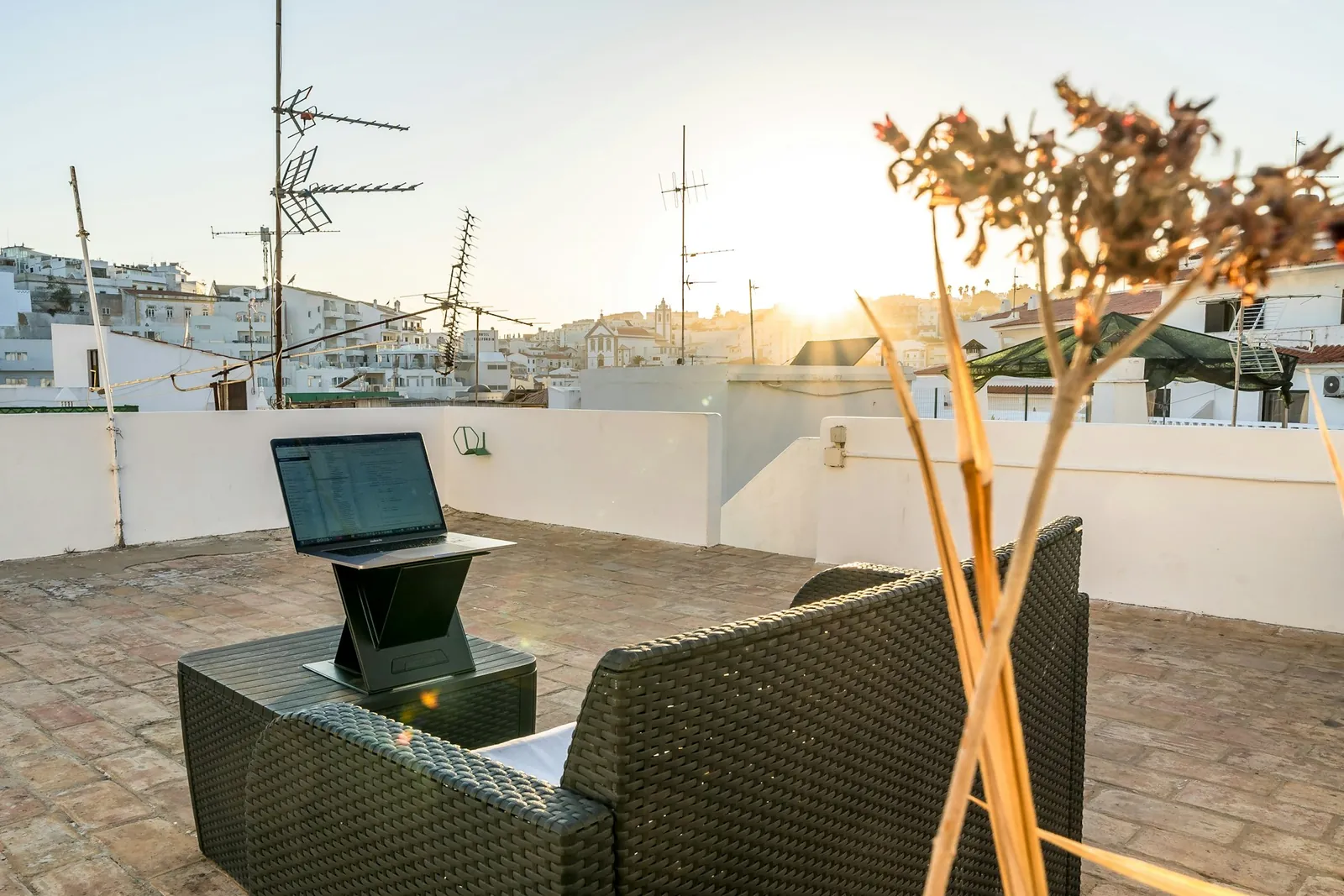
Arguineguín works well as a remote-work base: the clock matches the UK, flats usually come with Wi-Fi, and the days are bright. The part to get right is not the broadband but the paperwork behind a longer stay.
Working from Arguineguín is easy on the practical side and fiddly on the legal side. The Canary Islands keep the same clock time as the UK all year (WET in winter, WEST in summer), so a call at 10:00 in London is 10:00 here, and the working day lines up with Ireland and Portugal as well. Mainland Spain is an hour ahead, which is a small bonus for anyone with UK colleagues. The rules are the less obvious part: how long you may stay, whether you may work at all while you are here, and how Spanish tax looks at your days.
This page is about the day-to-day setup. The visa for non-EU remote workers who want to live here has its own page: Spain's digital nomad visa.
Internet: what to sort before you arrive
For most laptop work, the question is not whether the town has connectivity but whether your flat has a decent line and a place to sit. Mobile coverage along the south coast is good enough for video calls in most places, but a rental's Wi-Fi is the thing that actually decides how your week goes. Our page on mobile and internet in Arguineguín covers eSIMs, data plans and hotspots, so we will not repeat them here.
Before you book a month or more, ask the host three things in writing: which connection type the building has (fibre or something slower), whether the router is yours to use without a data cap, and whether the work surface and chair are real ones. Photos of a sofa with a laptop on it are the usual warning sign. Keep a data eSIM as a backup for the day the building connection drops.
Where to work in Arguineguín
Arguineguín is a working fishing town, not a coworking district. No coworking space in the town is documented, so assume your workplace will be your flat or apartment, plus the odd café for a change of scene. Coworking spaces on Gran Canaria are concentrated in Las Palmas and in the Maspalomas and Playa del Inglés area; check the operators' own pages for day passes and monthly desks, and weigh the trip: the bus to Maspalomas is straightforward but it adds time to a working day.
A few habits help in a town like this. Pick a flat with a quiet room away from the street, since the seafront is lively in the evening. Work early: the light is good, the heat is lower and the town is calm. Leave the sea until the afternoon. And if you plan to stay for months, the daily rhythm described in our guide to long-term stays applies equally to a laptop worker.
Time zone and the working day
UK-based staff do not have to adjust their hours: the clock is the same, and daylight in winter is generally longer than back home. For clients in continental Europe, Spain's mainland time is one hour ahead of the Canaries, so a 09:00 meeting in Madrid or Paris is 08:00 here. For US East Coast clients, a meeting in the late afternoon in New York falls in the evening here. Check the daylight-saving dates, because the US and Europe change on different weekends and the gap shifts briefly.
The rule that catches people: working while on a tourist stay
This is the part to read twice. A British visitor may stay for up to 90 days in any 180 without a visa (see the 90/180-day rule), but that permission is for tourism, family visits and similar short purposes. The FCDO notes that the requirements for working in Spain are different and that you may need a work permit or work visa; its guidance on the subject points you to the Spanish government's rules. Whether quietly working on a laptop for a foreign employer during a holiday is acceptable is not something the entry guidance spells out, so do not treat it as settled in either direction. If remote work is the main purpose of your stay, ask the Spanish consulate or an English-speaking immigration lawyer before you travel.
The Spanish government has created a specific route for people who work remotely for companies outside Spain: the international teleworker visa and residence permit, set out in Spanish law (Ley 14/2013, articles 74 bis to 74 quinquies, added in December 2022). It is covered in full on its own page.
The 183-day tax line. Under Spanish personal income tax law, you are generally treated as resident in Spain for tax if you spend more than 183 days in the calendar year here, and short trips abroad can still count as time in Spain. That is separate from your visa status. A third winter month and a long summer can quietly push you over it.
Tax and social security: why a short summary is not enough
The UK and Spain have a double taxation agreement so that income is not taxed twice, and GOV.UK advises consulting the Spanish Tax Agency and taking professional advice, for example from an English-speaking lawyer or a registered gestor. If you become resident, you must declare assets held outside Spain and may need to file an annual return. Whether you owe UK National Insurance while working from the EU is another question GOV.UK asks you to check.
For holders of the international teleworker authorisation, Spain's Ministry of Inclusion states that registering with Spanish social security is mandatory: employees through an employer registered as a non-resident company, or via an international social security agreement where one applies; self-employed workers through the autonomous workers' scheme. None of that is a reason to be scared of the idea, but it is the reason this is a subject for a tax adviser, not a travel guide.
Practicalities that make a working month smoother
- Power and plugs: Spain uses the continental two-pin plug, so bring adapters for a UK laptop charger and for a monitor if you carry one. The basics are on the plugs, water and time zone page.
- Heat and screens: a shaded desk with a fan or air conditioning matters more than people expect on a bright day. Check that the flat has one before you commit.
- Insurance: health cover for a longer stay is its own question; see travel insurance, GHIC and EHIC.
- Money: a Spanish-compatible bank card and a plan for cash are covered in money, cards and cash machines.
- Costs: what a month actually costs is on the cost of living page.
Canaryguide.info has a broader overview of the islands as a remote-work base, if you are still choosing between them: the Canaries for digital nomads.
Frequently asked questions
Is the internet good enough for remote work in Arguineguín?
Mobile coverage on the south coast is generally good, and most rentals advertise Wi-Fi, but quality varies by building. Ask the host what connection the flat has and whether there is a data cap, and keep an eSIM as a backup.
What time zone is Gran Canaria in?
The Canary Islands use Western European Time (UTC+0) in winter and Western European Summer Time (UTC+1) in summer, the same clock time as the UK all year. Mainland Spain is one hour ahead.
Is there a coworking space in Arguineguín?
No coworking space in Arguineguín is documented. Coworking is concentrated in Las Palmas and the Maspalomas and Playa del Inglés area, so check those operators for day passes.
Can I work remotely on a tourist stay in Spain?
The visa-free stay is intended for tourism, family visits and short business purposes, and the rules for working in Spain are separate. The entry guidance does not settle remote work for a foreign employer, so ask the Spanish consulate or an immigration lawyer if work is the reason you are coming.
Do I have to pay Spanish tax if I work remotely from Gran Canaria?
It depends on your residence. Spanish law generally treats you as tax resident if you spend more than 183 days in a calendar year in Spain. Take advice from a tax adviser or the Spanish Tax Agency on your own case.
Is there a visa for remote workers?
Yes, for non-EU nationals: the international teleworker visa, created in Spanish law in December 2022. Its requirements and process are on the digital nomad visa page.
Sources
- FCDO: Spain entry requirements – 90 days, working in Spain
- GOV.UK: Living in Spain – working, tax, National Insurance
- BOE: Ley 14/2013, articles 74 bis to 74 quinquies (international teleworkers)
- BOE: Spanish personal income tax law, article 9 (183 days)
- Spanish Ministry of Inclusion: FAQ for international teleworkers (in Spanish)